
What Is A Sourdough Starter?
It’s a live, bubbling colony of wild yeast and bacteria. You feed it flour and water, and it wakes them up. They eat and multiply, give off CO₂ and acids, and voilà—you have a natural leavening agent that ferments bread, pancakes, crackers—anything that rises. It’s alive, unpredictable, and utterly game-changing.
Why You Will Love Sourdough:
- Zero commercial yeast.
- Tangy flavor that deepens over time.
- It buds new sourdough goodness—you can split, store, gift it forever.
- You control the flavor: milder in winter, stronger in summer.
- It gives your bread structure and chew with pure ingredients.
Health Benefits
Wild fermentation breaks down gluten, making flour easier to digest. It neutralizes phytic acid so minerals absorb better. And because you feed it whole grain flour, it’s nutrient-dense biodiversity. It’s food with a living heartbeat.
Because I Love Good Food
You’re not reaching for packets or premixes—you’re creating a living thing that bakes with soul. This isn’t science class. It’s your first step to bread that impresses guests, fills your home with aroma, and connects you to tradition. You feed it. It grows. You bake with it.
FAQs
Q: How long does it take?
About 7 days of daily feeding—results depend on temperature and flour.
Q: Can I use whole-wheat?
Yes. Whole-wheat or rye speeds fermentation.
Q: What if it smells bad?
A bit tangy or sour is good. Rancid or moldy? Start over.
Q: What consistency?
Thick pancake batter at each feeding.
PrintHow to Make a Sourdough Starter
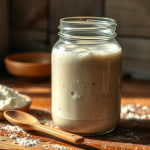
A 7-day guide to cultivating a bubbling, tangy starter that’ll power sourdough loaves, waffles, and beyond.
- Prep Time: 5 minutes per day
- Additional Time: 7 day ferments
- Cook Time: 0 minutes
- Total Time: 7-8 days
- Yield: 1 batch
- Diet: Vegan
Ingredients
Unbleached all-purpose or whole-wheat flour
Filtered water (room temperature)
Instructions
- Day 1: In a jar, mix 50g of flour with 50g of water until uniform. Cover loosely and let sit at ~70°F for 24 hours.
- Day 2: Check for bubbles (if none, good). Discard half of the starter (about 50g), then feed 50g of flour and 50g of water. Mix and rest 24 hrs.
- Days 3–6: Repeat Day 2. You should smell tang and see daily bubbles and rise. Stir every 12 hrs for a flavor boost.
- Day 7: Starter should double within 4–6 hours after feeding. If so, it’s ready to bake. If not, continue daily feedings for another week.
Notes
- Use a scale—baking is math.
- Temperature matters—warm = faster; cold = slower.
- Always discard; you don’t want a gallon starter.
- Whole-grain flour = faster rise, but stronger acidity.
- If mold appears, trash it. Start fresh.
Sourdough Starter Maintenance
- To use daily: discard half, then feed (50g each of flour + water); wait for doubling.
- To store in fridge: feed, let rise 2 hrs, cover tightly, refrigerate. Feed once a week.
- To revive a fridge starter: take a jar, let it warm up, discard half, feed, and wait for it to double at room temp.
Helpful Resources
- “Bread Baker’s Apprentice” for scoring and hydration tricks
- online starter tracking logs (ratios, temperatures, active times)
- community forums for troubleshooting
Final Starter
You didn’t just preload yeast—you cultivated a living culture. That jar of flour and water is now a powerhouse that makes bread rise, flavours develop, and kitchens smell like tradition. You feed it, and it gives you structure, tang, and that professional-grade chew in every loaf.
You’re no longer buying packets—you own your bread’s destiny.

